Serving Fitchburg, MA and surrounding areas. (978) 906-8756
MapleLane Fitchburg Concrete is a licensed concrete contractor serving Waltham, MA with decorative concrete, concrete driveways, and foundation services. We have been working throughout the Route 128 corridor since 2022, carry a Massachusetts HIC registration, and bring full liability insurance to every job in Waltham, whether it is a Highlands Colonial or a South Side triple-decker.
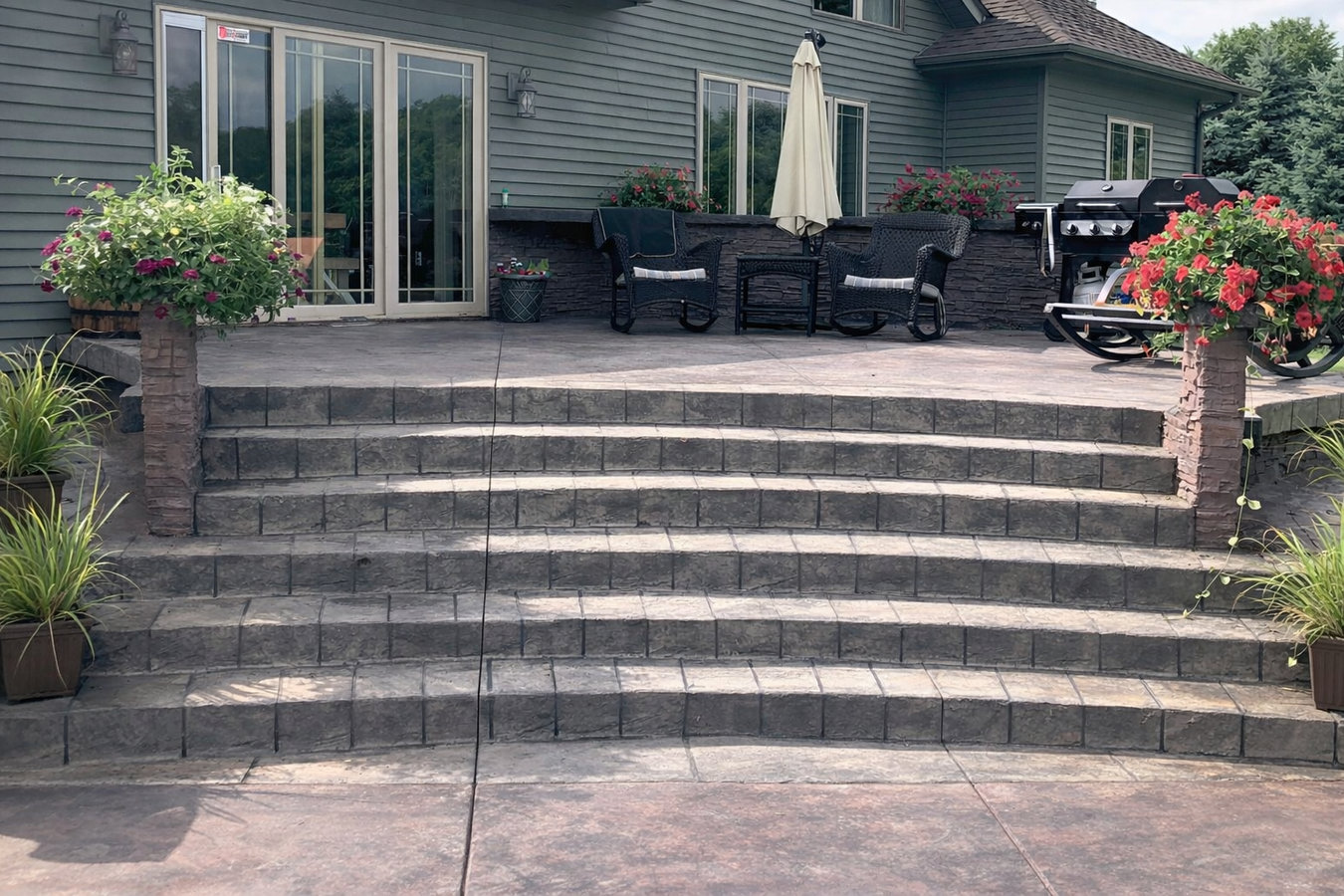
Waltham homeowners in the Highlands are increasingly pairing updated landscaping with finished outdoor surfaces, and plain gray concrete does not hold up visually against a freshly painted Colonial or a renovated yard. Our decorative concrete service covers stamped patterns, stained finishes, and exposed aggregate for Waltham driveways, patios, and walkways. Every decorative job we do in Waltham includes base preparation designed for the local freeze-thaw cycle and a sealed finish that protects the surface through the roughly 48-inch snow year this city sees.
Many driveways in Waltham's older neighborhoods were originally poured in the 1940s and 1950s, without the gravel base depth or joint placement that modern work requires. After five decades of freeze-thaw cycles and heavy use, those slabs crack, heave, and drain toward the house instead of away from it. We excavate fully, assess soil conditions, compact a proper gravel base, and pour a driveway graded to shed water away from the foundation. On lots near the Charles River corridor where the water table sits closer to grade, we take extra care with drainage design beneath the slab.
Waltham's Highlands neighborhood has a mix of single-family Colonials and Capes sitting on larger lots where outdoor living space is a real selling point. A patio built for a Waltham winter is not just about the pour; it is about the base depth, the control joint layout, and the grading that keeps water moving away from the house and the foundation. We size every patio for this climate and put the drainage plan in the estimate so you know what you are getting before work begins.
Front entry steps and side-door landings on Waltham's older homes take a beating every winter. Ice, rock salt, and repeated freeze-thaw movement break apart prefabricated steps that sit on shallow beds, and steps that were not set on proper footings start to rock and separate within a few seasons. Poured-in-place concrete steps, set on footings below the Massachusetts frost line and matched to your home's exact rise-and-run, stay level and attached to the house.
Properties in lower Waltham neighborhoods near the Charles River and the Reservoir deal with saturated soil through late winter and spring. Retaining walls on these lots carry hydrostatic pressure behind them every season the ground stays wet, and a wall built without proper drainage aggregate and weep holes will eventually bow or crack. We install footings below the frost line and design drainage behind every wall we build in Waltham to account for the wet springs this area sees.
Waltham sits about 10 miles west of Boston in a climate that delivers roughly 48 inches of snow per year and hard ground freezes from December through March. The city is also one of the most historically dense areas in Middlesex County. A significant share of its homes were built before 1960, and many predate World War I. That means the concrete on those properties, whether it is an original driveway, a basement floor, or a set of front steps, has been through anywhere from 60 to over 100 Waltham winters. The freeze-thaw cycle that hits from February through April, when daily temperatures swing above and below 32 degrees repeatedly, is the primary reason concrete in this city degrades faster than homeowners expect. Slabs without deep gravel bases or control joints fail well before their time.
The Charles River adds a second pressure to properties on the city's south side and along lower-elevation streets. Low-lying areas near the river carry a water table that rises during spring snowmelt, and the clay-bearing soils in much of eastern Massachusetts hold that moisture against foundations and beneath slabs for weeks at a time. Homes in these neighborhoods deal with hydrostatic pressure that pushes on basement floors and cracks foundations from outside. Concrete work done in this part of Waltham needs to account for drainage at every stage, from base design to finished grade.
Waltham's housing mix also shapes what kind of work comes up most often. The Highlands has primarily single-family Colonials and Capes on modest lots, where driveways, patios, and front steps are the most common projects. Closer to downtown and the South Side, triple-deckers and two-family homes built between 1890 and 1930 have larger flat roofs, shared exterior access stairs, and basement areas that drain poorly. A contractor who knows which neighborhood they are walking into knows what to expect before the first shovel goes in the ground.
We pull permits for Waltham projects through the Waltham Building Department, which handles permits for both residential and commercial concrete work across the city. Waltham covers about 13 square miles and includes a range of conditions: the higher-elevation Highlands neighborhoods with better-draining soils, the denser South Side streets with narrow lots and tight access for equipment, and the lower Charles River corridor where soil moisture is a year-round concern. Each zone requires a different approach to base work and drainage design.
From Brandeis University and the surrounding neighborhoods in the northern part of the city to the older mill-district streets along the Charles River near the former Waltham Watch Company factory buildings, we have worked across every part of this city. Route 128 runs along the western edge of Waltham, making it straightforward for our crew to reach properties on either side of the city without significant delay.
We also serve communities neighboring Waltham. Homeowners in Woburn, which sits directly north of Waltham along I-93, will find that area covered by its own service page. For homeowners to the south and west in the Framingham area, Framingham is served separately with its own local content.
Call or submit the contact form and describe what you need. We respond within 1 business day. We will ask basic questions about the surface type, approximate area in square feet, and whether existing concrete needs to be removed. No commitment at this stage.
We visit your Waltham property, inspect the existing surface or ground, assess drainage patterns and soil conditions specific to your location in the city, and determine how much base preparation the project requires. This visit is also how we give you an accurate cost. You receive a written, itemized estimate at no charge. We walk through every line item before you decide.
We apply for all required permits through the Waltham Building Department before any work starts. You do not need to go to city hall or schedule inspections yourself. Once permits are secured, we put your confirmed start date and project timeline in writing.
Our crew handles demo, hauling, base preparation, pour, and finish. We clean up the site at the end of each work day and give you a full walkthrough when the job is complete. For decorative projects, we go over curing timelines and sealer maintenance before we leave.
We serve Waltham homeowners from the Highlands to the South Side to the Charles River neighborhoods. Written estimates, all permits handled, no-pressure process.
(978) 906-8756Waltham is a city of about 62,000 people in Middlesex County, sitting at the intersection of Route 128 and the Charles River about 10 miles west of Boston. It has been an industrial city since the 1820s, when the Boston Manufacturing Company established textile mills along the river, and it later became famous as the home of the Waltham Watch Company, which made the city one of the most important precision-manufacturing centers in New England for over a century. Today, Waltham is home to Brandeis University and a dense corridor of biotech and technology firms along Route 128, which locals and newcomers alike call the "Golden Semicircle."
The housing stock reflects that long history. The Waltham Highlands, on the higher ground north of the commercial center, holds a concentration of single-family Colonials and Capes, many built between the 1920s and 1950s, on modest lots with mature trees and older landscaping. The South Side and downtown neighborhoods have higher densities, with triple-deckers and two-family homes built between 1890 and 1930 to house the factory workers who kept Waltham's mills running. Near the Charles River Reservation, the parkland along the southern edge of the city, properties sit at lower elevation and can see saturated soil and basement moisture during wet springs. About half of all housing units in Waltham are renter-occupied, a number higher than most nearby suburbs, which means the city has a significant landlord market alongside its owner-occupied base.
We cover Waltham and the communities around it. For homeowners to the north along I-93, Woburn has its own dedicated service page. To the south along the Route 128 corridor, Framingham shares many of the same postwar housing characteristics as Waltham and is served separately.
Custom concrete driveways built to last through New England winters.
Learn moreDurable outdoor patios designed for comfort and long-term performance.
Learn moreSafe, level sidewalks installed to code for residential and commercial properties.
Learn moreStructural retaining walls that control erosion and reshape your landscape.
Learn morePrecision floor pours for basements, workshops, and commercial spaces.
Learn moreSolid entry and exterior steps crafted for safety and lasting first impressions.
Learn moreProperly reinforced slab foundations for new construction and additions.
Learn moreComplete foundation systems installed to meet local building requirements.
Learn moreHeavy-duty parking lots engineered for high-traffic commercial use.
Learn moreServing these cities and communities.
Call us at (978) 906-8756 or use the form below. We cover all Waltham neighborhoods and respond within 1 business day.