Serving Fitchburg, MA and surrounding areas. (978) 906-8756
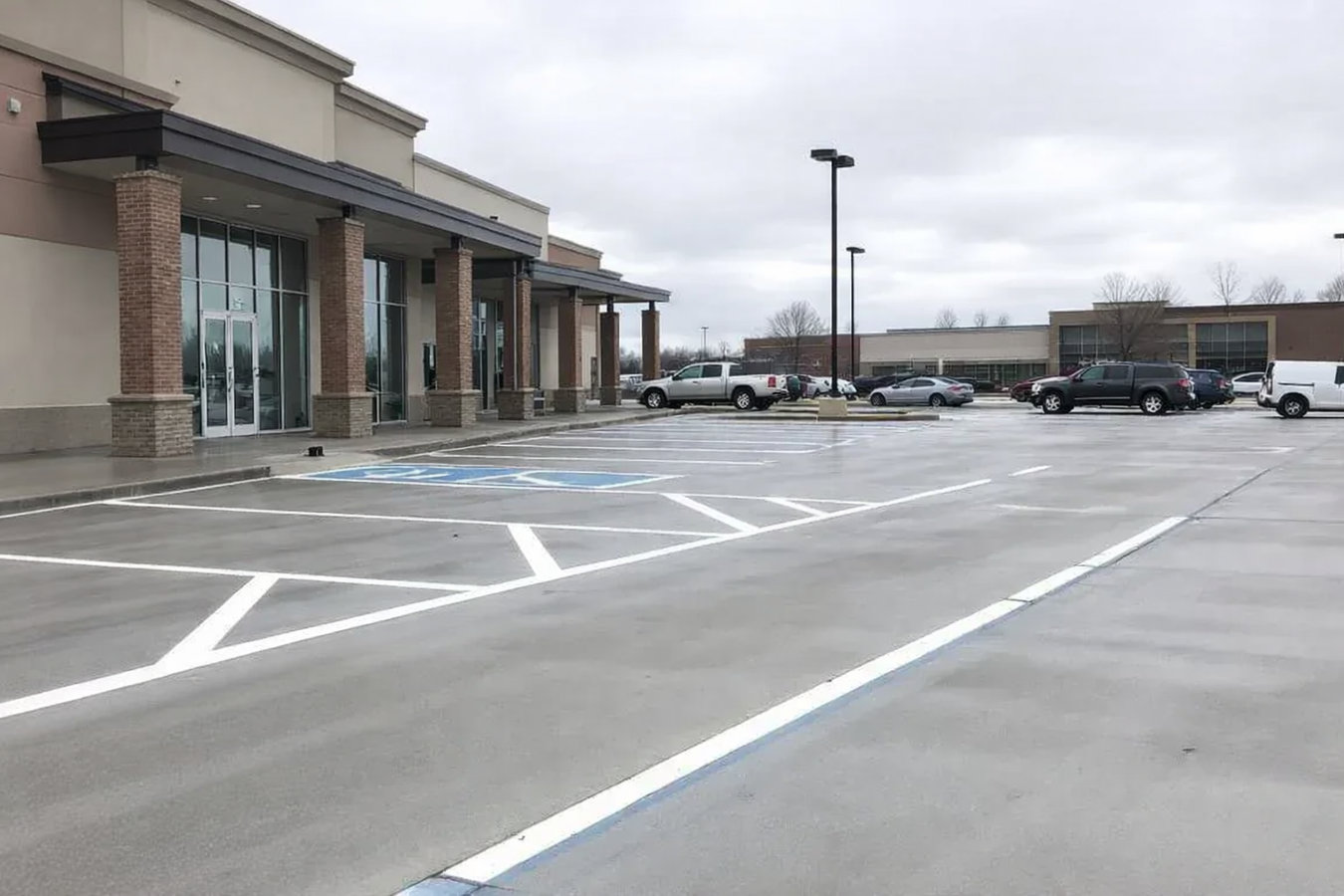
Cracked, uneven parking surfaces cost you every winter. A properly graded and reinforced concrete lot, designed for Fitchburg's freeze-thaw climate, holds up to daily traffic and stays looking sharp for 30 years or more.
Concrete parking lot building in Fitchburg means excavating the site, compacting a crushed-stone base, pouring a reinforced concrete slab with proper drainage slope, and cutting control joints before the concrete sets - most small to medium lots are completed in two to five days of active work, with vehicles kept off the surface for at least seven days after the pour.
The part that determines whether your parking lot lasts 30 years or starts cracking in five is almost entirely invisible: the base preparation under the surface. Fitchburg's freeze-thaw cycles are hard on every paved surface, and a slab without a properly compacted gravel base has nothing solid to rest on when the ground shifts in winter. Parking lot concrete in this climate also needs to be designed with drainage built in so water never sits on the surface long enough to work its way into hairline cracks.
If your project also involves adding a concrete driveway to the property, or you need structural support from concrete footings for adjacent construction, those scopes can often be coordinated on one project to reduce mobilization time and cost.
If you have patched the same cracks two or three times and they reopen every season, the base underneath is no longer stable. In Fitchburg, repeated freeze-thaw cycles work on existing damage year after year. When cracking is widespread rather than isolated to one spot, a full replacement is typically the more economical long-term choice.
Standing water on a paved surface is a sign that drainage is not working, either the slope is wrong or the surface has settled unevenly. In Fitchburg, pooling water will freeze overnight and accelerate surface damage. If puddles are still there hours after rain stops, that is a problem worth fixing before the next winter.
If parts of your parking area are noticeably lower than others, or a vehicle rocks when parked in a certain spot, the base beneath has likely shifted or settled. On older Fitchburg properties, fill soil from past use can compact unevenly over time. An uneven surface is also a trip hazard and can damage vehicles.
If you are converting gravel or grass to a parking area, or adding a second vehicle and need more paved space, starting fresh with a properly designed slab means the entire surface drains and wears consistently. Extending an aging lot is rarely as cost-effective as building a new one from the right base up.
We build concrete parking lots for residential and small commercial properties throughout Fitchburg and the surrounding area. Every project starts with a site visit to assess the existing surface, grading, and drainage before we quote. We handle excavation, aggregate base installation and compaction, concrete forming, the pour itself, control joint sawcutting, and final cleanup. All required permits go through the City of Fitchburg Inspectional Services Department, and we schedule city inspections at each required stage.
For properties converting an unpaved area to concrete, we grade the site so the finished slab sheds water away from any nearby structures. This matters especially on Fitchburg's hillside lots, where runoff can become a real problem if the drainage direction is not planned carefully at the start. We also factor in Massachusetts stormwater rules from the beginning of the design, not as an afterthought, so you are not retrofitting drainage features after the concrete is already in.
If your project includes other concrete work on the same property, including driveway construction connecting to the lot, or structural concrete footings for a building on the same site, combining the scopes means one mobilization, one timeline, and a finished project where all the concrete was installed with consistent materials and technique.
Suits properties converting a gravel, grass, or unpaved area to a properly designed concrete lot from a clean start.
For properties where the current asphalt or concrete has reached the end of its service life and patching is no longer cost-effective.
Suited to Fitchburg properties where site grading, stormwater runoff, or proximity to a building foundation requires drainage planning.
For business owners and landlords in Fitchburg needing a properly permitted and inspected concrete surface that holds up to regular vehicle traffic.
Suits homeowners adding square footage to an existing lot while matching the surface level, drainage direction, and concrete specification of the original.
For projects where clean concrete curbing or defined lot edges are needed to manage where vehicles park and where water drains.
Fitchburg sits at a higher elevation than most of eastern Massachusetts, and it sees more freeze-thaw cycles per winter than coastal or lower-elevation parts of the state. That means temperatures crossing the freezing point repeatedly throughout the season, often dozens of times between November and April. Every time water gets into a crack in a paved surface and freezes, it expands and makes that crack bigger. A parking lot built without proper drainage, correctly spaced control joints, and an air-entrained concrete mix designed for freeze-thaw resistance will show it within a few winters. The Portland Cement Association publishes guidance on designing concrete surfaces for freeze-thaw climates, and those standards inform every parking lot we build here.
The hilly terrain throughout Fitchburg adds a layer of complexity that flat-city contractors do not always account for. When a site slopes, water has to go somewhere, and the design has to ensure that somewhere is away from your building and your neighbor's property. Massachusetts also has stormwater rules that apply when you add a new impervious surface like a concrete lot. Getting drainage right at the design stage is far less expensive than retrofitting it after the concrete is in. Homeowners in Leominster and Gardner face similar site conditions to Fitchburg, and we apply the same drainage-first approach in both cities.
Fitchburg's older commercial and industrial properties, many dating from the mill era of the late 1800s and early 1900s, can also present excavation surprises. Buried debris, old foundations, and fill soil that was not compacted properly when it was placed are all real possibilities on properties with a long history. A contractor who has worked in Fitchburg before will ask about the site's history upfront and is less likely to be caught off guard, and less likely to hand you an unexpected bill mid-project. Homeowners in Worcester share similar conditions given the region's shared industrial heritage.
We visit the property in person to assess grading, drainage, and access before giving you any price. We reply within one business day to schedule that visit, and you receive a written quote, not a ballpark figure, within a few days of our time on site.
Once you approve the quote, we apply for all required permits through the City of Fitchburg Inspectional Services Department. Permit processing typically takes one to two weeks. You do not have to manage any of the city paperwork - we handle it.
The crew arrives to excavate the existing surface, grade the subgrade, and compact a crushed-stone base layer before any concrete arrives. This is the most disruptive phase. Expect one to two days of equipment on site and some disruption around the work area.
On pour day, we place and finish the concrete in a single continuous operation, then sawcut control joints into the surface while it is still workable. The surface is covered or treated with a curing compound. Plan on keeping vehicles off the lot for at least seven days.
No obligation, no pressure. We visit the site, assess the terrain and drainage, and give you a written price before you commit to anything.
(978) 906-8756We pull every permit through the City of Fitchburg Inspectional Services Department and manage the inspection schedule at each required stage. You do not have to navigate city hall. When the project is done, you have a permit record on file, which matters if you ever sell or refinance the property.
We work across Fitchburg and the surrounding Worcester County area. Contractors who work this region regularly understand the freeze-thaw conditions, the soil variability, and the short pouring season that shape every project here. That local knowledge reduces surprises on your job.
Every quote we provide includes a drainage assessment for the site. On Fitchburg's sloped lots, getting the grade right before the concrete is poured is the difference between a lot that sheds water properly and one that pools against your building every time it rains.
We carry Massachusetts Home Improvement Contractor registration, required by the state for any contractor doing work on residential properties. You can verify registration through the Massachusetts OCABR. This registration means you have recourse through a state oversight body if anything goes wrong.
Concrete parking lots are a long-term investment. A lot built correctly in Fitchburg will still be looking solid 30 years from now. We bring the same material specs, drainage discipline, and permit process to every job, whether it is a two-car residential lot or a small commercial surface, because cutting corners on any of those steps is what causes the cracking and pooling problems homeowners are trying to get away from in the first place.
Structural concrete footings dug below Fitchburg's 48-inch frost line for decks, additions, and outbuildings.
Learn moreResidential concrete driveways sized and graded for your Fitchburg property, from two-car aprons to full-length approaches.
Learn moreFitchburg's concrete season runs from late April through September. Get your estimate now so you are on the schedule before the summer rush closes out available dates.